A Conversation with Lloyd Alexander about The Golden Dream of Carlo Chuchio
How do you start working on a new book? Is your approach or way of working different now, after writing so many books, than it was early on in your career?
Fear and trembling would be a good start. What I’ve mainly learned is how to handle large stacks of paper. My approach—or hope—has always been the same. I try to make each book different and to push at my own limitations. So, every book is an altogether new experience, as if for the first time. I’ve never been there before, I don’t know the territory. I can’t rely on the past—except for the large stacks of paper—and the future is always problematic.
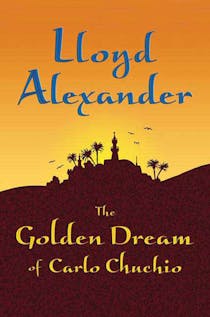
Can you tell us about the inspirations that led you to write The Golden Dream of Carlo Chuchio?
That’s a reasonable, clear, simple question—and one of the hardest for me to answer. Let me go at it this way. I tend to work from the inside out, from the internal to the external. That’s not to say I don’t find ideas or inspiration in odd news items or peculiar events. A big part of the process, and the most chaotic, is understanding my own frame of mind at the moment. What means the most to me? What do I feel compelled to say? How to express it? I don’t know all the answers to begin with and have to hope I’ll find them along the way. Maybe with Carlo, I somehow wanted to look at the world head on. And find it astonishing. Sometimes astonishingly good, sometimes astonishingly bad. But always astonishing. And full of mysteries. The strange working out of destinies. And dreams.
You’ve set this story in such a rich, vibrant time and place. How did you come to choose this setting?
Once I had a general (i.e., vague) idea of the story’s shape and its emotional underpinnings, I did a really quick scan of 10,000 years of world history. To me, the best place was fifteenth-century Persia. Here’s a world of teeming bazaars, caravans, scorching deserts, lost cities, brutal warlords, dangers at every turn—hey, we don’t have such things in Drexel Hill.
Do you see yourself in any of the characters? Are they based on people you know?
Pretty much all of the characters, in some way or another, are based on people I’ve known for a long time. Namely, me. In creating characters, if writers can draw on any of the infinite facets of their own personalities, I think they’re dealing from strength. Instead of intellectual fabrications, the characters have the spark of life. Sometimes they can even turn out more interesting than their author.
Do you have a favorite scene in the book?
All right, I won’t try to dodge that question even at the risk of overlooking many favorite scenes. True enough, whenever that sublime rascal Baksheesh opens his mouth I burst out laughing. But my thoughts keep circling back to the Bazaar of All Dreams and the defining moment between Carlo and the beautiful Kirkassi girl Shira. Her words at the chapter’s end still haunt me: "Who but lovers dream alike?"
What scene was the hardest to write?
The last page of the last scene. For me, this has always been the case. After all, you’ve spent a significant part of your life caught up in characters you’ve invented but which, to you, are totally real. You’ve had emotional experiences of your own even beyond the actual writing. Now your part of it is done. Never, never will you go back there again. That’s something of a wrench. You’re not the same person you were when you began. Nor should you be.
Are there any scenes or elements you wanted to include in the book that just didn’t end up fitting into the final story?
None I can think of. I have to hope that maybe this time I got it right. As objective as I can be (which is never really objective), the architecture is right, the structure works. There’s no excess baggage. Things planted early on come to surprising fruition later. Nothing is wasted. Fine, all well and good. But the reader still has the last word.