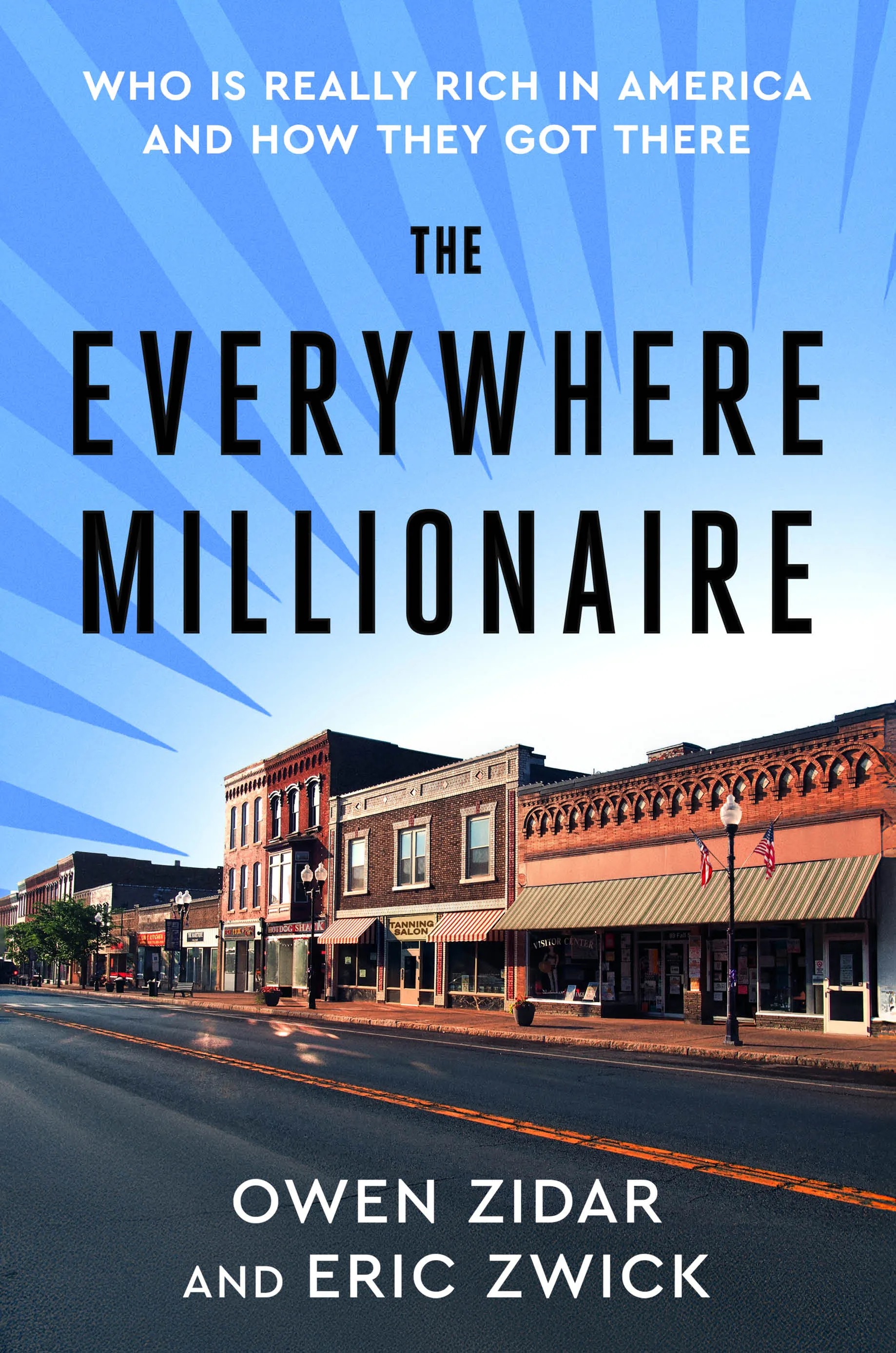
Introduction
Who are the rich in America?
Perhaps the most popular measure of wealth in America is the Forbes 400, which lists the nation’s richest people. In 2025, the top of the list features familiar names like Musk, Bezos, Gates, and Zuckerberg. Below them are family dynasties like the Waltons and Kochs, finance titans like Ken Griffin and Warren Buffett, entertainment bigwigs like George Lucas and Steven Spielberg, and sports team owners like Jerry Jones (Dallas Cowboys) and Robert Kraft (New England Patriots).
About three-quarters of the Forbes 400 are owners of public companies or tycoons in finance, tech, and real estate. TV paints a similar picture with shows like Billions and Succession—the former about a hedge fund manager set in New York and Connecticut, the latter about a media patriarch and his family dynasty set in New York.
Yet these titans (fictional or otherwise) are but a sliver of the nation’s truly rich. Wealth in America is more abundant, and closer to home, than most people think.
The Brockways, whose vast wealth came from a family car dealership, are hardly unique. In nearly every city and town, so-called small business owners have built extraordinary fortunes running ordinary businesses.
Some are entrepreneurs who launched their own ventures, working long hours and reinvesting the profits to stay afloat and grow. Others inherited a family firm, continuing and building upon the success of prior generations.
Pop culture portrays the rich as an elite few, akin to the Rockefellers and Carnegies in the nineteenth-century Gilded Age. In reality, rich private business owners are now so plentiful that we’re living in America’s first Age of Millionaires.
* * *
What do we mean by rich?
We define the rich as households with at least $5 million in wealth, which means they are in the top 4 percent in household wealth in America as of 2022. Wealth combines both liquid holdings (bank accounts, stocks, etc.) and illiquid holdings (businesses, real estate, etc.) and subtracts debt (mortgages, student and car loans, etc.).
Nearly five million households clear that threshold, including more than two million decamillionaires (at least $10 million), and around sixty-five thousand centimillionaires (at least $100 million). Most of them own a private business—as do three-quarters of decamillionaires and nearly all centimillionaires.
We define Main Street Millionaires as the rich owners of private businesses. As of this writing, they number about three million. Their average wealth is around $25 million.
Collectively, Main Street Millionaires have more than thirteen times the wealth of the Forbes 400. For every member of the Forbes 400, more than four thousand private business owners each have at least $10 million in net worth. For every large public company CEO, more than one thousand private business owners each have at least $25 million in wealth. Far more than a few high-profile billionaires on the coasts, these are the real rich in America.
These successful business owners are growing not just in number but in the size of their wealth. The number of decamillionaire business owners has more than doubled since the early 1990s (even after adjusting for inflation), and the number of centimillionaire business owners has nearly quadrupled.
As many business owners reinvested in their firms, benefited from economic growth, and enjoyed lower interest rates and taxes than those of earlier decades, their business valuations and collective wealth boomed far more than that of the Forbes 400. (These same forces drove impressive growth among the Forbes 400 as well, but they remain a tiny share of the rich in America when compared to Main Street Millionaires.)
Main Street Millionaires are entrepreneurs who created, inherited, or acquired businesses in a diverse set of industries across the country. From Topeka to Omaha, Great Falls to Baton Rouge, owners and operators of so-called small businesses are richer than you’d think—and more powerful.
Half the Forbes 400 live in New York, San Francisco, Los Angeles, and Miami, and the other half tend to live in such big cities as Chicago, Boston, Atlanta, Washington, Dallas, and Houston. Main Street Millionaires, by contrast, live in hundreds of communities all over America.
Suppose that instead of flying from San Francisco to New York, you drove. You’d find more 5,000-square-foot homes along the way than in those two metropolitan areas combined. You’d find them in every town and city you pass—especially in glitzy resort destinations like Aspen, Park City, and Jackson Hole, but also in less well-known spots like Mackinaw Island, Lake of the Ozarks, Lake Minnetonka, and Lake Martin.
These are not only the homes of Main Street Millionaires; they are often their second or third homes. Take Kurt and Kathi Westman. They’re from Fort Wayne, Indiana, where they own and operate Al-Fe Heat Treating, one of America’s largest commercial aluminum heat-treating companies. They vacation in the Florida Keys, where they have owned a $42 million, 11,000-square-foot oceanfront home.
You probably know a Main Street Millionaire, even if you don’t realize it. They’re coaching your child’s soccer team, sitting next to you at community fundraisers, or chatting with you at neighborhood barbecues. They might be the dentist who expanded his office to a regional network of practices, the commercial HVAC contractor whose trucks you see around town, or the owner of that local restaurant chain that keeps opening new locations. They’re hiding in plain sight, as ordinary people who run businesses woven into the fabric of everyday life.
How did we discover them?
* * *
This book began with an investigation that was impossible until recently.
For decades, explorers attempting to map America’s wealth suffered a massive blind spot with most of American wealth blacked out. We knew about public company CEOs from SEC filings and billionaires from Forbes lists, but not private business owners whose fortunes were almost invisible. Their tax returns are confidential, their firms are unlisted, and no database connected owners to their companies, employees, or wealth.
That changed in 2014, when the Treasury Department asked us to help figure out how much business owners were paying in taxes. To do so, we built the first database that connects the data on tax forms to individual businesses, their owners, and their employees. We could link business owners to their businesses and those businesses to their employees. (The names of the individuals and businesses who submitted these forms is confidential information stored in a distinct database from the de-identified and anonymized data we analyzed.)
That data proved a gold mine. With it, we discovered a hidden world of rich business owners. For the first time, we could fill out the full map of American enterprise—from small firms to the richest Americans—and see who owned what, how much they earned, where they lived, and how they built their fortunes.
These data enabled us to learn about private business owners all the way up the income scale, including in the top 10 percent, 1 percent, 0.1 percent, and above. What we found changed how we think about inequality: One of the most common explanations for why someone made it to the top was that he or she owned a large stake in a mundane business.
We tracked the journey of all the nation’s entrepreneurs from childhood through the years after they started and built their businesses. We pinpointed the key factors that enable them to thrive.
After a decade of work, we have painted the most comprehensive portrait to date of who the rich really are in today’s America, how they got rich, and how they are shaping our economic, financial, and political life.
* * *
Through our work, we discovered something that has driven the wealth of Main Street Millionaires and fundamentally transformed the landscape of American business—the explosive growth over the last forty years in the number of “pass-through” businesses.
In the tax code, pass-throughs are sole proprietorships, partnerships, limited liability companies, and S corporations. In plain English, they are doctors, dentists, accountants, lawyers, car dealers, real estate developers, restaurateurs, architects, building equipment contractors, consultants, computer system designers, and other professionals who organize their businesses as pass-throughs.
What’s behind the explosive growth in pass-throughs?
Largely, the tax code. Pass-throughs do not pay corporate or dividend taxes. Instead, their profits (and losses) pass through to their owners’ individual income taxes. In recent decades, lower tax rates for pass-throughs have driven business owners to adopt that structure.
Until the 1980s, traditional C corporations (like General Motors and IBM), which face corporate taxes, reigned over the economy. Now, pass-throughs are America’s dominant form of business. They reside in every region and operate in most business sectors.
Pass-throughs are hugely important in driving the wealth of Main Street Millionaires. In recent years, around 70 cents of every $1 of pass-through earnings go to those in the top 1 percent in income. Over 69 percent of the top 1 percent, and over 84 percent of the top 0.1 percent, earn some pass-through income. More than 1.1 million pass-through owners have yearly income over $500,000, 150,000 have income over $2.2 million, and 15,000 have income over $10.5 million.
Nontax factors also drove the growing wealth of Main Street Millionaires. Among them were falling interest rates, rising globalization, better technology, and deregulation, which delivered lower borrowing costs, higher business valuations, and access to bigger markets for many Main Street businesses.
* * *
In this book, we tell the stories of dozens of Main Street Millionaires, with information that we gathered from interviews and secondary sources.
How did we find them?
After learning that pass-throughs dominate the business world, we set out to identify the most lucrative ones and the people behind them. To do that, we looked, for instance, at industry publications that ranked top earners. We interviewed industry experts and combed through databases such as Dun and Bradstreet, which collects reams of information about businesses and their leaders. We also tapped our own networks. The more people we told about our quest to find rich private business owners, the more leads we gathered.
Once we identified the top earners in an industry, we learned more about them through public information, including newspaper and magazine profiles, registries of private jet and yacht owners, and property records for homes. That’s how we learned about Bob and Paula Brockway and their daughter’s “wedding of the century.” We interviewed dozens of multimillionaire private business owners who were willing to share their stories, and we collected more stories than we could write about.
Though we can’t be sure that every single Main Street Millionaire is a pass-through business owner, the explosive growth in pass-throughs and the concentration of pass-through income at the top tell us that the vast majority of them are, or have been, pass-through owners.
* * *
This book recasts fundamental popular notions about wealth in today’s America.
Part I introduces many of the Main Street Millionaires who are accumulating vast fortunes.
Part II traces where they came from and how they grew rich, revealing what their experiences say about the state of the American Dream and the many paths to prosperity.
Part III uncovers the political power of Main Street Millionaires—how they use their wealth and influence to shape politics and policy at the national, state, and local levels.
The story of Main Street Millionaires is largely unknown and hugely important. We sometimes call them the Stealthy Wealthy because they fly under the radar. Or, as a colleague put it, “Private business owners are the dark matter of wealth in America.” We want to make the rich visible and correct misconceptions about who they really are.
We seek neither to glorify nor vilify business owners. Some create jobs and help expand the economy, while others just line their own pockets. Regardless, understanding their rise is essential to understanding modern affluence and influence.
Across these pages, some stories may inspire you to pursue paths to prosperity that you had never considered. Others may raise questions about whether wealth is distributed and wielded fairly.
Either way, you’ll be better able to spot Main Street Millionaires in your own community, understand how they built their fortunes, and recognize how they are reshaping our everyday lives.
1The Rise of Pass-Throughs
We should continue to improve the pass-through provisions at every step.
—Rep. Kevin Brady (R-TX), chairman, House Ways and Means Committee, December 9, 2017, in private correspondence during Congress’s debate over President Trump’s tax cuts that year
When Ronald Reagan was starring in low-budget B movies from the late 1930s to the early ’60s, he never wanted to make too many movies in any one year. If he earned too much, he’d find himself in the top individual income tax bracket, which meant that he’d take home as little as nine cents for every dollar he earned. That experience drove his desire to cut top tax rates when he became president in 1981.
In the early 1980s, Reagan was joined by supply-side economists and congressional Republicans like Senator Bill Roth (R-DE) and Rep. Jack Kemp (R-NY) in a push for low tax rates, which they all argued would spur economic growth. Reagan also found common ground in loathing the tax system with a Democratic senator, Bill Bradley (D-NJ). While the former paid top rates as a Hollywood actor, the latter suffered the same fate as an all-star forward for the New York Knicks.
Democrats like Bradley and Rep. Dick Gephardt (D-MO) proposed to clean up the tax code by eliminating scores of tax credits, deductions, and other write-offs. These provisions not only made the code hard for average Americans to understand but they also made it fundamentally unfair because the benefits of such tax breaks accrued mostly to special interests.
The combined Republican quest to cut taxes and Democratic quest to simplify the code drove the Tax Reform Act of 1986, a landmark bipartisan achievement. It was the biggest reform of federal taxes in more than thirty years.
What none of these legislators anticipated was that the act would fundamentally transform America’s economy—in particular, its corporate sector—by driving an explosion in the number and size of a once-arcane type of business entity known as the pass-through.
The explosion in pass-through businesses helped usher in the Age of Millionaires, and it also created a paper trail that made Main Street Millionaires visible for the first time.
* * *
Let’s briefly step back in time.
From the founding of the Republic until the early twentieth century, the nation raised tax revenues largely through import tariffs and excise taxes on goods like whiskey. To finance the Civil War, President Lincoln and Congress established an income tax in 1861, but lawmakers repealed it in 1872. The Supreme Court ruled in 1895 that a federal income tax on property was unconstitutional.
The excesses of the Gilded Age spurred efforts to find a viable way to sustain a federal income tax. Ratified in 1913, the Sixteenth Amendment granted the federal government the necessary authority.
The income tax rate on the very rich, which was only 7 percent in 1914, rose dramatically to 77 percent by 1918, helping to finance America’s involvement in World War I. In the decades to come, lawmakers raised or lowered tax rates to reflect the mood and needs of the times. After falling to 25 percent in 1925, the top tax rate rose to 63 percent during the Great Depression and to as high as 94 percent during World War II. To finance wars and, especially after World War II, pay for ever-growing federal domestic programs, the government also collected revenue from corporations but at a lower tax rate (which peaked at 53 percent in 1968).
The individual tax had more brackets than it does today, and the top rates applied to a narrow sliver of the population. In 1950, the highest tax rate applied only to those making more than $2.5 million a year (in 2025 dollars)—three times higher than the top threshold today—and only those above the top 0.01 percent in income were in that tax bracket. Nevertheless, through the 1970s, the top 1 percent of earners still faced marginal tax rates of at least 60 percent.
The tax code has long given business owners several tools to minimize their taxes. Historically, business owners preferred to pay corporate rather than individual income taxes because the top individual tax rate was always at least as high as, and often higher than, the corporate rate. By creating a traditional C corporation, business owners could pay the lower corporate tax rate on their earnings. They could also enjoy extra tax benefits like writing off company cars, family vacations, and country club memberships as business expenses.
When Reagan was elected president in 1980, the top individual tax rate was 70 percent, and the corporate rate was 46 percent. Tax reform in 1986 cut the top individual rate to below the corporate rate—triggering a multi-decade transformation in the structure of American business ownership.
That brings us to pass-throughs. The income that a pass-through generates is not subject to corporate or dividend taxes. Instead, its profits (and losses) flow through to the individual income taxes of its owners. From 1986 to 2017, with top individual income tax rates lower than corporate rates, and with lawmakers giving pass-throughs more tax breaks, business owners had big incentives to organize as pass-throughs. Millions of business owners converted their C corporations into pass-throughs or set up new businesses as pass-throughs.
In essence, tax reform changed the face of American business. Before the 1986 act, traditional C corporations produced almost all business income, and nearly all employers adopted this form. Now, 95 percent of all businesses are pass-throughs. They employ half of all workers and generate the majority of business income.
And this transformation served another purpose. Because pass-through tax obligations flow to each owner, pass-through tax returns marked a new trail for us to follow the money.
* * *
The Treasury building sits next to the White House on Pennsylvania Avenue, in the heart of downtown Washington.
In the plaza outside the Treasury’s south wing, atop a nine-foot marble base, stands a ten-foot bronze sculpture of Alexander Hamilton, the nation’s first Treasury secretary, in knee breeches and ruffled cuffs, a hat in his right hand and a coat draped across his left arm. His eyes are steady, his face is calm, and his stance projects the resolve of a man who built the nation’s financial foundations. Anyone who wants to enter the building must pass through multiple security checkpoints. Inside, one traverses checkerboard marble floors, gazes at vaulted ceilings and towering pillars, and walks on circular staircases. It’s a humbling place to work.
If you descend one of the staircases to the basement, you find a row of windowless offices, with bookshelves of tax code reference manuals and fifteen-year-old IT equipment. It was in one such space, in Treasury’s Office of Tax Analysis (OTA), that we started our investigation. When a president wants to propose a change to the tax code, OTA estimates how much it will cost (if it’s a tax cut) or raise (if it’s an increase). OTA is a nerdy place; we fit right in.
In the summer of 2014, we finished graduate school—Zidar at the University of California at Berkeley, Zwick at Harvard—and moved to Washington with Danny Yagan, a friend who had finished his graduate work at Harvard two years earlier and who joined us on the project to help the Treasury Department figure out how much tax business owners were paying. As we would soon discover, that was no easy matter.
We rented a three-bedroom apartment in Shaw, a gentrifying Washington neighborhood not far from the Treasury Department. The owner was an artist who decorated the place with exhibits from Peeps, the Easter candy. We commuted to work in shared Ubers, and we wrote, ate, coded, and brainstormed together.
Our office mates called us the “Three Amigos” but, privately, we adopted a sillier nickname: the Tax Ninjas.
* * *
The IRS collects voluminous, confidential information about businesses and their owners. But it’s stored in a labyrinth of separate systems and databases, making it hard for anyone to use it to paint a clear overall picture of those businesses and owners. That is what we were trying to do.
One system stored information on the revenues, profits, and industries of millions of businesses, while a separate system stored information on hundreds of millions of individual taxpayers, including tens of millions of people who might or might not be business owners. Another included information on how we might connect the data in those two systems. Each system was designed to help tax auditors investigate cases of alleged wrongdoing by specific taxpayers, not to enable anyone to conduct an economy-wide analysis of all taxpayers.
Policymakers, pundits, economists, and others perennially propose different ways to tax rich individuals and profitable firms. That explains in large part why policymakers have changed the tax code so often over the years. Two years before we got to Washington, that issue once again took center stage when President Obama squared off against Republican nominee Mitt Romney in the 2012 presidential election. At issue was what to do about President George W. Bush’s tax cuts of 2001 and 2003, which were set to expire soon after the election. (As it turned out, lawmakers extended the vast majority of them before their scheduled expiration.)
As White House and Treasury officials over the years sent tax proposals to OTA to evaluate, staffers identified a problem. Because of the siloed IRS databases that did not link to one another, they couldn’t fully understand how the existing tax code influenced taxpayers and shaped federal revenues, much less predict the impact of any reform. This blind spot was especially large in the case of pass-throughs.
Over sandwiches at Woodward Table restaurant a block from the Treasury, we debated how to link everything together. Danny would order the merguez sandwich, which was so spicy it caused him to break out in sweat every time he ate one.
We had already dug through dusty IRS codebooks to understand the different names that various databases gave to the same information. For example, “profits” in one database meant “total income” in another. The names in the IRS books corresponded to boxes of tax forms that didn’t always match the tax forms stored on the server. Names would change from one system to another. And all these items required translation to become useful as economic concepts.
We drew diagrams over lunch to map out a plan to build a new dataset. After finishing our sandwiches, we returned to the office and tacked our sweat-stained notes to a corkboard.
* * *
The data are massive. They cover every company and individual in America multiple times. Working with such data required numerous security trainings and background checks as well as the constant vigilance of researchers to prevent the unauthorized disclosure of protected information. Gaining access to each dataset required documentation, justification, and multiple approvals.
Meanwhile, the IRS computers storing all this information were outdated and, as a result, slow. Starting around 2010, Republican lawmakers began a successful decade-long effort to slash the IRS budget, forcing staff cuts and leaving the agency without the funds to serve the public well and modernize the IRS’s computers.
Working for the federal government in an underfunded agency meant using legacy servers with limited file storage space, putting up with frequent service outages, and enduring automatic security upgrades that left our computers unable to function. When many users were on the server, the system would slow between keystrokes. We waited hours for others to finish running their programs before we could run our own.
Poorly structured queries from us to the computers would take days to run, if they ran at all. Often, the first few times we tried something, we’d wait long hours for the computers to process code until we received an error message or the computers stopped pursuing our task because, for instance, we left out a semicolon somewhere. We’d then have to rerun the whole program. Zwick’s experience as a software developer proved helpful when we needed to use arcane programming languages from the 1980s to circumvent system limitations.
We spent hours waiting on the IRS technical help desk to troubleshoot the random times when our passwords refreshed, our data access changed, or some other computer update prevented us from working. We eventually learned the best way to move our help desk ticket to the front of the line: scream the words “complete work stoppage.”
Copyright © 2026 by Owen Zidar and Eric Zwick